
AI Product Manager / Independent Builder

I design AI products that help people think through making, inspect the results, and keep shaping the work.

IDEAS DEVELOP THROUGH MAKING.

Help people keep shaping the work.

Building mstudio keeps bringing me back to the same moment: a storyboard reveals a composition that needs changing; playback reveals an unfinished action. Creative intent develops in response to the work. The product needs to make room for that change.

I focus on what people need to see, what they can change, and how far a change should reach. AI can take on execution and coordination while people retain creative judgment. Real tasks help me check whether that division reduces rework and repeated explanation.

Product choices, grounded in real work.

  1. 01mstudioAI VIDEO STUDIO · IN DEVELOPMENT2026 — NOW
  2. 02AI GTM SYSTEMSTEALTH AI PRODUCT · 0→12026 — NOW
  3. 03BUZZYAI ADVERTISING WORKFLOW2025.08 — 2025.12
  4. 04SIDERWEB CREATOR & WISEBASE2024.09 — 2025.08
01AI VIDEO STUDIO · IN DEVELOPMENT2026 — NOW

mstudio

A desktop video studio where creators can begin with an incomplete idea and discover what they want through scripts, storyboards, and actual footage.

THE QUESTION

How can an AI creative tool help people move forward before they know exactly what they want, while preserving the parts they already like?

DESIGN & PRACTICE

  • Made scripts, the canvas, and the timeline editable working objects so that intent can develop after people see a result.
  • Organized conversation and direct editing around specific objects, letting creators choose when to delegate and when to adjust the work themselves.
  • Separated specialist judgments, narrowed the scope of local changes, and removed a separate review step that was not reducing the work of checking results.

MSTUDIO / PRODUCT DESIGN NOTES · OCT 2026

How can a product help before people know exactly what they want?

A storyboard can change the composition someone wants. Actual footage can reveal a problem with action or pacing. In my own production work, many requirements emerged only after I saw a result. mstudio is organized around that process: express an idea, see the work, make a judgment, and keep revising.
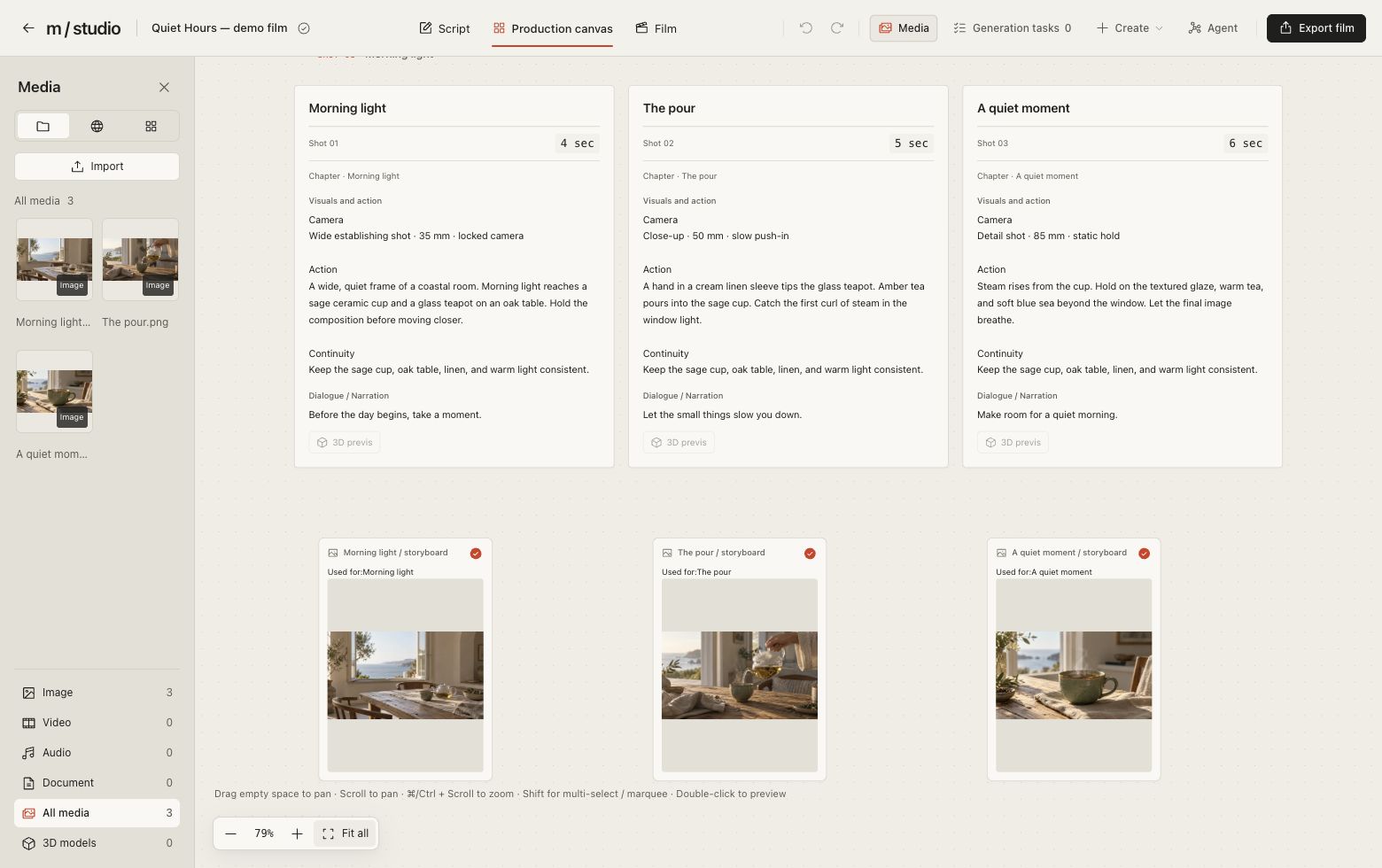
The current English mstudio production canvas with three shots and tea ritual storyboards from the fictional Quiet Hours project
An isolated browser preview of the current English interface. Quiet Hours is a fictional demo with illustrative script and conversation, and AI-generated media. This capture demonstrates the workspace.
01

Let intermediate work help people discover intent

Scripts, storyboards, and the timeline make story, composition, and timing available for judgment. I kept these objects editable so people can decide what comes next after seeing the work. They can revise a stage or finish only the part they currently need.

Choice: keep useful creative surfaces while removing technical nodes and separate approval flows that users would have to manage.

02

Move between delegation and direct editing around the same work

A creator can reference a shot and describe a change, or adjust a clip directly on the timeline. Both act on the same project, so the person does not need to transfer a chat suggestion into the editor again. Agents handle execution while the creator retains judgment over the image and its timing.

Choice: offer one working context and call specialists as needed, without requiring every task to pass through the entire production process.

03

Preserve the parts people already like

A task to change shot 01 once expanded into a whole-film review. Editing a generation task also overwrote a shot draft. These incidents made the target and reach of a change explicit product requirements. People should be able to predict what their instruction will change and what it will preserve.

Choice: treat a task description, a reusable shot draft, and a new generation as separate actions. Reading more context must not silently expand the edit.

04

Keep specialist coordination inside the product

Deciding how a shot communicates an action differs from deciding how to draw a particular frame. I separated shot direction from storyboard artwork so each role could address its own judgment. Creators still express goals around scripts, shots, and clips; the system takes on coordination between roles.

Choice: add specialization where a distinct judgment is needed; disable a separate review role when it does not reduce my own checking work.

05

Evaluate automation by the work that remains

A continuation test on September 27 produced a 23-second film, but required interface confirmations, external frame inspection, and corrected cut points. A completed first edit did not mean the actions had been preserved. Those incidents help me examine how much work a person still has to do after the system finishes.

Choice: distinguish saved changes, a successful export, and content quality. A finished task is not evidence of a satisfactory film.

02STEALTH AI PRODUCT · 0→12026 — NOW

AI GTM SYSTEM

A system that turns product facts into testable GTM hypotheses, real market touchpoints, and growth signals—helping early teams decide what to do before writing more code or buying traffic.

THE QUESTION

AI has made pages, copy, and ads inexpensive to produce. Early teams still lack a continuous workspace that connects hypotheses, launches, signals, and decisions.

DESIGN & PRACTICE

  • Defined the product loop from Brand → GTM Loop → Surface → Signal → Decision Brief
  • Designed multi-agent collaboration, workspace canvases, landing-page generation, and publishing flows
  • Worked across positioning, pricing, SEO, Meta Ads synchronization, and technical architecture
  • Used the real building process to test product boundaries instead of optimizing for an AI demo
  • Product Strategy
  • Agent Workflow
  • GTM Experiment
  • Full-stack
03AI ADVERTISING WORKFLOW2025.08 — 2025.12

BUZZY

An AI workflow for small advertising teams and creators that connects competitive research, campaign planning, and video generation.

THE QUESTION

Creative production takes time, competitor research depends on manual work, and planning is disconnected from video generation. Small teams struggle to sustain the cost of iteration.

DESIGN & PRACTICE

  • Led more than 15 user interviews and systematically compared eight competing products
  • Defined a differentiated research → planning → generation journey and a free-form canvas
  • Designed four subscription tiers and a credit model to balance access, compute cost, and gross margin
  • Designed a multi-agent architecture using YAML orchestration, Temporal execution, and multimodal models
04WEB CREATOR & WISEBASE2024.09 — 2025.08

SIDER

Across an AI no-code site builder and a personal knowledge base, I translated between product definition, RAG design, prompts, backend delivery, and growth.

THE QUESTION

Enable non-technical users to move from description to generation and refinement, while making file management, semantic search, and AI conversations a dependable knowledge workflow.

DESIGN & PRACTICE

  • Studied Bolt.new, Lovable, V0, and Figma-to-code tools to define the non-technical audience
  • Shaped core interactions and prompts, and delivered key WebCreator backend services
  • Defined Wisebase file management, RAG semantic search, and AI conversation capabilities
  • Designed document chunking, vectorization, retrieval strategy, and the foundational service framework
2025.12 — NOWLEARNING THROUGH REAL USE

Independent AI Product Builder

Independent building lets me turn a product hypothesis into a working tool and use it through a complete task. In mstudio, I am refining the path from an idea through scripts and storyboards to editing, asking where people need to judge and where an agent can take over.

I judge automation by the checking, rework, and repeated explanation still needed after it runs.
  1. 01OBSERVE
  2. 02FRAME
  3. 03BUILD
  4. 04USE
  5. 05REVIEW
  6. 06REFINE

Engineer by training. Product by practice.

From edge devices and infrastructure to AI workflows and commercial products. Technology is not a separate path; it is how I understand constraints and move product work into delivery.

  1. 2025.08 — 2025.12
    ZMO
    Technical Product Manager

    Led requirements, product design, technical reviews, monetization design, and cross-team delivery for an AI video creation product line.

  2. 2024.09 — 2025.08
    SiderWeb
    Technical Product Manager

    Owned market and user analysis, requirements, and technical solution design while contributing to backend, prompt, agent, and RAG implementation.

  3. 2023.11 — 2024.09
    自研 AI 笔记
    Product Lead / Builder

    Took an independent AI notes product from market research and Figma prototypes through full-stack development, AI features, subscription payments, cloud deployment, and operation.

  4. 2021.09 — 2023.11
    科大讯飞AI Learning
    Software Engineer

    Built infrastructure, a task-flow framework, OTA capabilities, device services, and internal open-source foundations for an AI translation pen.

  5. 2021.04 — 2021.08
    罗克佳华集团IoT Platform
    Software Engineer

    Contributed to IoT platform positioning and architecture, including multi-protocol device access, device shadows, and business automation.

  6. 2019.06 — 2021.04
    成都鹏业软件Research Institute
    Software Engineer

    Led feature design, hardware selection, and the video-stream framework for a Jetson edge-recognition terminal, and contributed to the internal IoT platform.

Product judgment in the details of use.

A

PRODUCT JUDGMENT

Start with the work people are trying to finish and decide which part the product should own.

  • User Research
  • Positioning
  • Competitive Analysis
  • Pricing
  • Roadmap
B

AI SYSTEMS

Define which judgments belong to people and agents, and how people can take over.

  • Human–AI Collaboration
  • Context Boundaries
  • Local Editing
  • Agent Roles
  • RAG
C

SHIP

Build a usable tool, then trace problems through real inputs, actions, and results.

  • React
  • TypeScript
  • Go
  • Python
  • Cloud & Infrastructure
D

GROWTH

Look for separate evidence that a product works, that people choose to use it, and that they will pay.

  • GTM Experiment
  • SEO
  • Meta Ads
  • Analytics
  • Decision Brief

OUTSIDE THE WORKFLOW

I also photograph people and streets.

Outside product work, I photograph people and streets: light, passing gestures, and small moments that will soon be gone.

Let's build something people can understand—and use.